Joyce Farmer's Special Exits really goes there in examining the trauma of aging. It was interesting, in that it wasn't Joyce's memoir at all, but the story of her parents. My head was thrown for several loops as I progressed through the book, attempting to figure out just what Joyce's story was in the midst of this. I had several questions (and still do): what happens when you write a third person memoir? What did people think
about the speediness of the passage of time (time goes on...time tangoes
on...months later...)? Did it feel rushed, or were these simply a
compilation of the more interesting tales of their lives? How did Joyce
know these moments were happening if she was not witness to all of it,
except maybe through Laura's eyes? It makes me wonder how she framed the
story overall. Also, how did she know where to end the chapters? Those are the questions, what follows are my thoughts.
It's more confusing (but not so confusing that I can't follow along -- I love this narrative!) when I read Joyce's own biography. She's a radical feminist who wrote underground comics in the 70s, such as Abortion Eve, either prior to or right after Roe v. Wade. (Here's the link to that here, if you're interested: http://www.ep.tc/eve/ ). She was a G for this. Joyce herself was working class and raised in LA, and actually left
comics behind for real estate because she wasn't making a decent living from them.
Strangely enough, Robert Crumb convinced her in the 2000s that she
should write the story of her parents' latter days. When I saw excerpts from Abortion Eve, it sparked my interest in reading Special Exits, because I didn't know what surprises would creep from inside that house, courtesy of Rachel and Lars.
Everyone we've read so far in the class has located themselves front and
center, even while keeping their fathers -- or mothers -- as the focal
point. Mostly, they tell the stories of their parents to examine their
own life model and relationship to the world, and realize just how much
they were influenced by them. This doesn't seem to happen here. So, is
Laura a representation of Joyce? Did Joyce get involved in the pro-choice movement because she was influenced by her mother? It was a completely unexpected moment in the story when Rachel informed the young Sharalee that she should have an abortion, and made me wonder about Rachel's past. More interesting was the seeming contradiction that she's pentecostal Christian, if even for nostalgia's sake, and also pro-choice. Was she an abortion provider, or just a part of the movement? From this, I couldn't shake the feeling that this story was part-fiction, part-memoir. Is it? Does it even matter, really?
This moment is also a major shift in the book, as it introduces the intersections of race and class through Lars' and Rachel's story. They're living in South Central LA in the 1980s-90s (though Joyce chooses to call it South Los Angeles, which actually didn't happen until the 2000's), and they have lived in this house for decades, so much that they're indeed a part of the fabric of the neighborhood as much as the Black and Latino residents are. They seem comfortable there, although they're physically "stuck" and would like to live in a nursing home. I mean comfortable in the sense that they're not positing the fears that most white folks have when they think of South Central LA, including Rachel's son and his wife ("the neighborhood is dicey"! WTF), and the driver of the taxi, who wouldn't get out of the car ("she didn't like the neighborhood").
These suspicions come to a head when the LA riots happen (p 81), which I'm really glad were included here. The story weaved into the American fabric is any white person who appeared anywhere near South Central LA on that day was beaten, robbed, and the like; as Lars and Rachel watched TV, these fears were heightened. Lars watched the flames expand from his living room window, and Rachel remained scared; Lars' attempt to quell her fears were in this sentence: "But we've lived a long time." Not "we've lived here a long time", but "we've lived a long time". In that regard, he knew the residents of the neighborhood weren't going to harm/rob them because they're elderly, but there was the hint there that they were immune to harm because they've lived there for years. Even as the electricity got knocked out, Lars seemed a lot less hysterical than most would expect him to be. Laura was more worried sick about them than anything, and feared for her own life, as she was a white woman as well, but later found out no one was harming women. Turns out, as the smoke cleared, they all were completely unharmed.
This story points to an interesting view on working class/low-income white folks who live in low-income communities, who don't have access to certain resources. Concerning their declining health, much of it was due to them avoiding the doctors/hospitals, and their situations worsening as a result. I can attest to this, as many folks in low-income communities don't trust hospitals, and would rather rely on their own families or themselves to take care of their ailments. Another aspect of that is the cost of being "healthy": those bills, I'm sure, would've been enormous for their upkeep, and it is unclear whether or not they had insurance (I'm leaning to not). Lars and Rachel were highly suspicious of any outside person, and rejected Laura's suggestion numerous times that they should hire a nurse. They were steeped in denial, across many fronts: denial of aging or having illnesses, and denial of their own behavior contributing to their failing health. As many times as Laura insisted on them eating veggies -- even the ones she made them -- they would rather eat an entire block of muenster cheese and snacks. A huge part of this, too, is cost of food, and availability of affordable healthy food in South Central. That transition to health is a difficult one to make when you've been living your whole life a certain way.
Another aspect, too, is their hoarding, and much of it stemming from them growing up in poverty. As Rachel continued to make dolls, Lars justified it to Laura as: "Go easy on her. You don't know what it was like to be so poor. After we married I noticed she felt obliged to buy something at every store she entered." (p 66) This notion of holding onto things even when they have no immediate significance manifests through a feeling that you'll never have anything. It was a shift to see Lars getting rid of his stuff though -- the car, namely -- and this seemed to hint at accepting his fate.
Also this statement: "It's going to happen and we...must get ready. I'm 79. If I can get ready, you can." OOOOHHHH. I got CHILLS from this, and later, when the reaper decides to show up in his imagination (partially). It hit me even harder, because my own grandmother is also 79. She doesn't talk about her own death necessarily, but it makes me wonder when and if she thinks about as she reflects on her life. I'm always picking her brain and begging for her to tell stories, much like Laura; she has yet to begin having any major ailments, but she also is the one person in my family who never misses a check-up or her cholesterol meds. I know it's only a matter of time before we'll have to help her out with everything, and for her to accept her own elderly state, but as far as now goes, she just brought a brand new car for her 78th birthday and says to us, "I ain't old; I just been here a while."
Showing posts with label Unique. Show all posts
Showing posts with label Unique. Show all posts
Monday, March 18, 2013

Monday, March 11, 2013
"do not shoot the artist, she was doing her best."
(my dearest, dearest apologies for this insanely late blog. but, i had to get it in to show that i really, truly did have much to say about the book, and enjoyed it, no matter how disturbing it might've been for me.)
that quote at the back of the book hit me so intensely after reading this book through...and through...it's from the brilliant illustrator of the book, antonina gribnikova, but it can also apply to kalamity, the author/artist of the book. as i lifted each page, SO MUCH HAPPENED in such a shortly compacted space -- one where words danced, skirted, or s l i d across the black space behind it.
at first, i was met with my own limited knowledge of what graphic memoir is *supposed* to look like. i thought, well, where are her thought bubbles? not ONE? why can't we just call this a really visually disturbingly fucked up cautionary tale/illustration book for kids? then, i remembered weirdos exist in this world for a reason, to give two damns about what some thing is *supposed* to be. there's gotta be a reason we are viewing it as memoir...right?
i opened my brain up more and allowed it to unravel into each drawing. jesus, these drawings. i'll say, volume of books aside, Kalamity J is the complete invert of Alison Bechdel in terms of painting their childhood, their parents, the role of their mother in their lives, and healing old (and much still present) wounds. whereas Alison relies on not just memory, but extrapolating everything that the memory has brought up for her in order to best recreate or distort that memory (numerous author influences, multiple voices speaking at once, text, text, and more text..). Kalamity recognizes that everything in her memory is simply a blur, and takes us with her from there. she relies on the visual to paint these hazy pictures, and gives readers a great sense of disturbulation with each picture (new word! disturbing stimulation? i couldn't think of a word that matched what i felt and that one just was IT.). in short, Alison layers text for meaning, Kalamity layers her pictures (and the figures within them).
for one, Kalamity's memoir doesn't start with her: it starts with her parents. her childhood is marked by distortion before she even arrived into her own body, as her parents were party animals, equipped with alcohol, coke, and pills galore. the first picture is immediately gripping (literally) as a hand emerges from the top of the page and becomes the focal point -- almost -- as it is hard to focus on just one aspect of athe picture. each fingernail is surrounded by forks. this fork is a stunning motif throughout the memoir, as it at first represented the wining and dining of her parents, and later, to describe how similar she was becoming to her mother: "taste on the same fork. Scratching metal, biting time. Bitter." with each section, she changes fonts, sizes, and colors to lend a variety of moods to each, albeit with an everlasting bitter taste on the tongue throughout. Kalamity's poetry slices through and does not waste time getting to the point of just how distorted her parents' lives were; her mother's pain seeped through each line. in addition, she relays how she became her mother, although they have a strained and unresolved relationship.
the reader doesn't even see her face as a child until the second section, as a toy-like figure blocks her face. this could be representing how toys and recreation blocked her from seeing the forms of abuse already surrounding her. in contrast, we know from Alison's over-usage of Winnicott that the child is well aware of these dangers, but is helpless to express their thoughts -- some react outwardly, others run and hide. by the second section, she already has valiums for pupils, and splitting a six pack with her younger brother. also noteworthy is the page before, with the sequences of photos of Kalamity as a child, and how the shading lends an extremely depressing backdrop to her entire upbringing. the pictures are more shaded in black, and appear as black and white negatives of photos. it is already a reversed reality, one that can't be recalled as it originally was as it is too painful to face.
each detail she decides to give about her childhood is loaded and weighed down by pain, numbing the pain with vices, and a consistent cycle of the two, either through her mother or herself. the illustrations fittingly represent this as well. they are configured figures, made up of many parts, each of them playing into the next. even the fork, even pills, are split and re-envisioned. this kaleidoscopic reimagination of her memories is fitting, and feels like a drug-induced haze (given the haze from drug and alcohol use surrounding her); the black pages lend to the void, sinking feeling, or black hole that must have eclipsed her when her mother left after the day of graduation. her words are sparse, but the emotion is enormous in both what she does not say, and ESPECIALLY the paintings. gotta give it up for Antonina, man.
picture 31, of her mother as the "suburban gypsy", the onlookers with grass for eyes...a lot of gouging of eyes. terrifying. that picture on 33 especially? when the mother's mouth was an eye, and her eye was a mouth? WHOA. even if she paints in black and white or color, the emotion grips harshly either way.
i also must say i looked up kalamity's bio on the inkpen mutations website, and her bio is AMAZING.
"Done with the college salad days, she now stands in line at the soup kitchen, one minestrone cup away from Sallie Mae debtor's prison. So have a heart, and buy her books. "
YES.
Monday, March 4, 2013
page 32, things that make you go hmmmm.
i must say it has been quite the emotional weekend for me. seems like it's been that way for many other folks too (damn you, mercury!!), and a series of coincidences that bleed too easily into each other.
how is it that i was watching inception a few days earlier, have been completely obsessed with my dreams as of late, and attempting to crack the code on them to understand what's happening in my inner and outer reality, and begin reading this book, and witness Alison doing the same damn thing?
needless to say, i was BLOWN. i just couldn't stop talking about the book as i was reading it. it's pretty robotic to not read a book like this and not be reminded of my relationship with my own mother as well (i stopped being breastfed after a few weeks too! wahhhhh!) anyways. there were trace leftovers from fun home about her OCD that i was so thankful she went in depth to explain. again, she utilizes the voices of writers from yesteryear, but this time through the lens of psychoanalysts. at first, i was taken aback by this choice to pathologize herself and her experiences -- framing her life based on the analysts she was seeing (and really, really seeing), but then i realized we have something in common: the need to understand the patterns within us. it makes sense that she would incorporate Freud, Jung, and this fellow Winnicott into her work, as they professed in unlocking the puzzles of our dreams and our childhood. truthfully, the two are intrinsically related. and in her words, "the transcendent would almost always creep into the everyday" (32).
hell, she succeeded in making me want to pick up Freud and Jung's books, specifically, to apply them to my understanding of my own life.
the spread on page 32 is a super-interesting arrangement of how Alison views the beginning stages of her relationship with her mother. i must say, it immediately made me think of Oubapo elements. for one, Alison rearranges the photographs based on her own interpretation: increased happiness with every photo, and suddenly, tremendous fear in the final one. in each photograph, her mother's face is seen less and less. her mother as the maternal figure is there, but interrupted by her father's presence (although he's taking the pictures anyway). she taps into Winnicott's theories that by 3 months old, babies already have an emotional understanding of their surroundings and how they should and shouldn't behave. she is already singling out her father for his "rages", and essentially implying that the relationship with her mother was not an "ordinary" one. well, ordinary in the sense that they should foster a unique, inverse connection, of the mother being the child, and vice versa. she declares that this attachment was impossible, as her mother was too busy trying to dodge her father's "rages" and not spending enough time nurturing their own relation. hence, the rest of Alison's entire life, wondering who her mother even was in the first place and, on more than one occasion, wanting somebody, ANYBODY ELSE to be her mother instead. (that's also interesting, as it appears that who she gains knowledge and insight from is automatically fulfilling the maternal instinct for her: she mentions Jocelyn as her mother too, as well as Winnicott.)
more striking is Alison's ability to juxtapose these beginnings with their current relationship, and strategically (or not?) places their conversation across this spread. she's already established that this true connection was lost long ago, and it is evident in their imbalanced relationship today. you can always tell her mother is speaking based on the squiggly lines surrounding her text, which suggests she's either speaking loudly, or that Alison doesn't ever really take what she says seriously. "I couldn't believe Lady Gaga on the grammys last night. Puh-lease. I like punk. I like weird!" Then, Alison anchors this transition with her mentioning of the transcendent creeping, as even her mother is still haunted by dreams of her father. this reveals the unsettled guilt and frustration laden in their relationship, as Alison was always enamored by her father moreso than her mother anyway, although she was "wary" of him. as is custom in their family, her mother relates to her through discussing Sylvia Plath's journals, but still dismisses her as "a spoiled brat". (i am reminded about Alison's dream of the spider web as well, but i won't veer too far from here tonight.)
on the one hand, my eyes wanted to read each square panel together and go back and re-read her mother's commentary; on the other, Alison's intention to scatter her existential thoughts as her mother is speaking shows just how much respect she tries to have for her, but it always seems as though it falls short. she mentions that she sees herself as the parent, and her mother, the child in this relationship. this page is a physical embodiment of that experience, as the photos combine to tell one tale, and her words describe how they've related to each other ever since. also noteworthy is the gerber jar filled with ink, the red ruler dead-center in the page, her glasses, and the paintbrushes/scalpel. it seems as though her mother is a complete distraction from the work she was trying to do by calling her, although the work she is doing is about her. what a freakin conundrum.
Monday, February 18, 2013
"I think I started Ning or something. Ha ha!"
THE INITIAL:
it was initially surprising that alison bechdel decided to reveal, in insane depth, the memoir of her life, after creating a legacy of comic strips that even sustained me through my questioning teenage years. all i had to see was the word "dyke" in Dykes to Watch Out For, and it brought me closer to something i'd been repressing in myself.
with that said, i didn't expect to find many parallels between myself and bechdel's life story -- truthfully, there are many more differences, but nonetheless a thread of attempting to lend words to the unspoken, to undo our own repression, be enthralled by it, and later, bursting loose from it. she states it as, "i moved toward the thing i feared." (214)
bechdel's writing is a conundrum trapped in a conundrum, wrapped in a catechism, and worth $500 on the jeopardy daily double. it's an interesting and tiresome feat, it seems, to write about one's family in this way. that is, unless these are the emotions one associates with emotions, period. she and her brothers were raised within this, being spoonfed (in a much less intimate act) their parent's ellusive natures. her father, bruce, was trapped in a geographical and biological sense -- in beech creek, a town of 717 people, smack dead middle of pennsylvania, only united with the surrounding towns via highways. i, in my "80's baby"ness, was thankful for the historical markers such as these in the book, keeping in mind that the majority of this book took place from the 1930s-1980. alison structures a hodge podge of political events in their relevance to her life, be it by location, or parallel situations (nixon's watergate to her coming out/her father's case with giving beer to a teenage boy).
i could ramble about the whirlpool of elements bechdel incorporated to weave this tale -- the seamless metaphors from greek mythology about her parents, siblings, and herself, and the lovely, lovely "CANON!" of books her father loved. i really could. her brain is INCREDIBLE for creating such insanely complex analogies. but, rather than take you through the trenches of my brain for this, i'll focus on her childhood trauma, and its effects, both lasting and temporary.
because bechdel jumps back and forth through moments of her life in order to create a complete and thorough reflection on that tale, as if to get at the truth from all sides. she reveals little by little each chapter, and reflects on her prepubescence, teenage years, and college years as if they were a circular existence. through this, she is instrumental in identifying ways her own trauma shows up in her life, how it manifests, and her later reflection on it. as we mentioned in class, memoir is not necessarily chronological, nor are our memories -- our brains are all over the place as we try to retrieve insights and revelations about our life. she reimagined her father's death multiple times, with multiple possible conclusions, but was never ever truly sold on any of them. in fact, her father created a skeptic out of her before she could even spell it (though i'm sure she could!).
DESENSI-WHAT?
she managed to get as close as she possibly could to her father, though on the surface, the family unit was dissolving. the energy seemed consumed in helen and bruce's stale marriage: him, a closeted gay, she, stifled from pursuing acting. it didn't help that their literal environment/place of reference was a funeral parlor. from childhood, alison was able to intellectualize death with such a distance, even for her own sake when her father died. she likened herself to Wednesday from the Addams Family. A pivotal display of this was on page 44, when her father asks her to pass scissors to him as he stitched up a cadaver. the reflection over the last frame bears a, um, harbinger to her emotional reactions for the rest of her life:
"maybe he felt that he'd become too inured to death, and was hoping to elicit from me an expression of the natural horror he was no longer capable of...the emotion i had suppressed for the gaping cadaver seemed to stay suppressed." (44-45)
througout each frame, there is a slight percentage of shift in facial expression, noted in the weight under her eyes once she sees the body. she leaves the room, and her face is back to "normal". she later HA-HA's about the incident to a school colleague the same summer her father dies, so much that they think she's kidding.
OCD, REPRESSION, AND THE LIKE
her emotional trauma manifests mostly in repression, remaining vague and elusive, and developing symptoms of OCD. i realize now this is prior to the labeling of every illness and disorder, and the coercion to use pills to alleviate it (ahem, laurie sandell). sure, there was dr. spock, but alison saw from reading him that it was possible to reverse her own behaviors. still, it is unclear just what trauma caused this: her parents arguing (namely her father's verbal abuse towards her mother), or the intensely veiled attempt at showing love and affection to each other. she already knew she was the manifestation of this.
subsequently, she begins writing "i think" in her diary, as if an innate notion that nothing is true or certain, that she knew her father was overcompensating tremendously through this immaculate house (144). even if she never got the full truth, and had to hear it from her mother at 16, what child is full of such skepticism so early, and why? towards whom? this "i think" became a shorthand symbol later, and drowned out everything she thought was certain in her journals. these compulsive behaviors resulted from what Spock describes as a "repressed hostility". could it be to her mother? or father? (i can't wait to read are you my mother? for more possible answers...or revelations...on this topic.)
REPRESSION - close to freedom?
later, at 16, she couldn't even bring herself to tell her mother that she got her period for the first time. hell, she couldn't even tell herself, referring to it as "Ning", an algebraic reduction. (also, isn't that a little late? or are there just too many hormones in our food now that accelerate that process?) i remember writing in my diary as a teen and omitting what i didn't want to believe was real or true, or circumventing the topic, in similar ways (ahem, that whole "GAY" thing and being a then-Christian). i reflected and realized my mother's behavior was the exact same. in this, i empathize with a teenage alison, this behavior resulting from her parent's reactions and dealings with their own lives. it's one thing for a teen to not want to tell their parents in defiance, but she'd been procrastinating that conversation for half as long as the "coming out" one.
for one, her mother was wrapped up in a series of situations at once, trying to create art that freed her, while still being restricted in many other senses. in general, when her parents argued, there were several things happening. bechdel located it in several parts of the house, there were several family members. it was a consistently jumbled environment that tried too hard to pose as ordinary. this would create emotional hesitation and repression in a child, wouldn't it?
later traumas manifest in a multitude of forms: she wants to believe she had something to do with him committing suicide, and refuses to let go of the slither of shaky evidence for this, as it is for her, the last bond the two share posthumously (86). they each embodied what the other didn't have; "the end of his life coincided with the beginning of my truth", she states. simultaneously, she even felt like his parent! at another point, she calls it reverse oedipus complex. shit's deep.
it amazes me that alison didn't have the same hangups about relationships as laurie sandell in the impostor's daughter, as they had been lied to equally, only to uncover more as they aged. fortunately for alison, her queerness was repressed for so long, and filtered through her father's queerness: he freed her up to be a queer, and to dive face first (PUN INTENDED) into her sexuality. even if she never got her mother's full approval, she was certain of this fact. she was queer at heart from childhood, in every sense of the word -- equipped with qualms, and a knowing that she was different from other girls. more qualms than answers followed her, until she recognized a qualm in her sexuality she was certain about, unlike her father. (it's also interesting he backhandedly considered her a "hero" for coming out, but at the expense of him being the anti-hero...hmmm).
the last example are the panels on 220-221 when she almost comes out to him in the car, and with each painstaking panel, you think she's getting close...but instead, the words are engulfed by darkness and silence. even if she thought they were "inversions of one another" (98), there's still that last veil on their relationship that prevents the truth from shining through. it's ironic that alison is now brilliant at communicating her feelings, the nuanced connections in her life and literature, and the intensely loquacious nature of her writing -- as she had such difficulty communicating her true self to her parents. i guess these things are born out of that silence...
FINAL THOUGHT:
i also wonder what folks thought about her choice to include SO much secondary text: actual paragraphs, definitions, specific journal entries, text from other books and newspapers, as well as actual letters from her parents. how does this lend to the authenticity of her memoir, even in its attempt to highlight the grey area of everything, including truth?
at home...and it ain't fun
hey folx! my dearest dearest apologies for not yet posting to the blog. i came down with an unfortunate bout of stomach pains last nite, which may be food poisoning related. the only word i can say to describe how im feeling is ugh. i'll try to have something cohesive to say by this afternoon. so much love, even thru the pain!
Monday, February 11, 2013
*insert tale of artsy young white hipster living in brooklyn here*
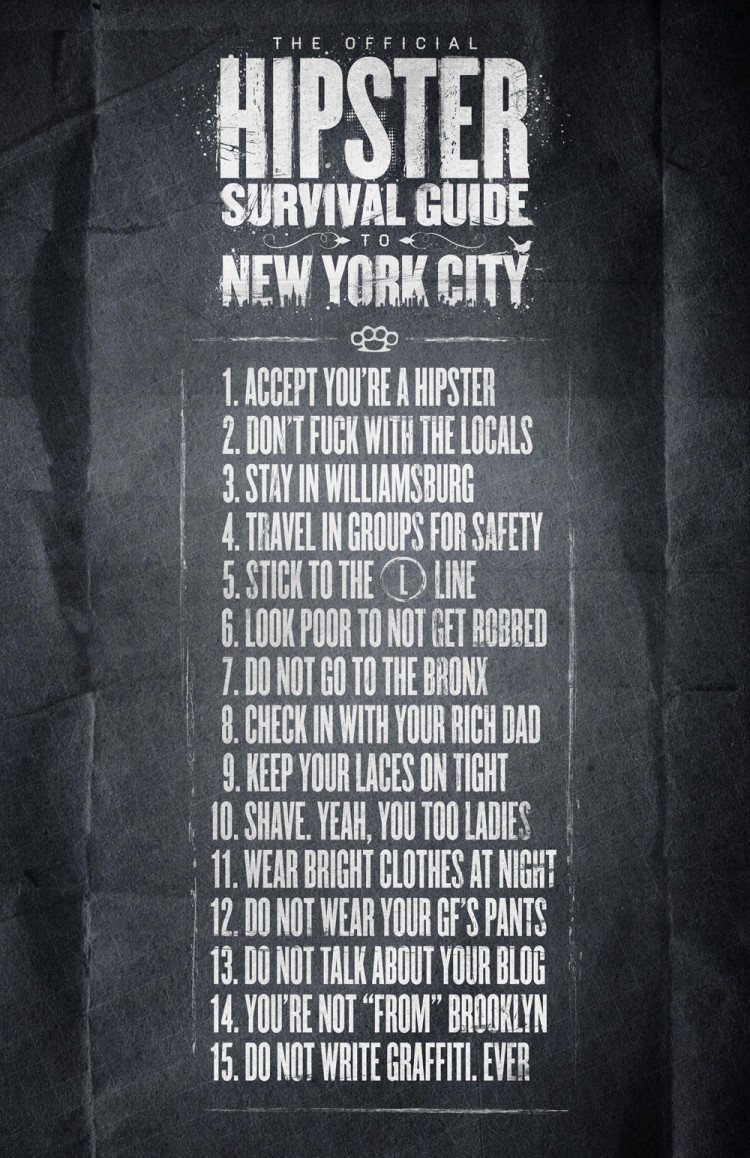
well, what can I say about Lucky that hasn't already been summed up in the "first world problem" memes, or this "hipster survival guide to new york city" list?

"MOVE TO BROOKLYN, THIS IS WHERE IT'S REAL! BESIDES YOU'LL GET TWICE THE SPACE AT HALF THE PRICE!"
-miranda, friend living in bushwick. yawn.
this above statement makes me cringe for numerous reasons. i for one, spent two years living in brooklyn as well, but spent each day of that time thinking about my newfound hike in class privilege, graduating from hampshire and moving right to new york. i was now the first of my family who lived outside of baltimore, and it both thrilled and confused me. was i gentrifying, living next to families who have been in nyc for generations? did it make a difference that i was black? on the surface, yes, as i didn't stand out in flatbush. but i, too, was a part of a "wave", and i had to be conscious of this and accept it. hence, it even made my blood boil to watch communities transform, rents soaring through the roof, new coffee shops and sushi restaurants springing up, with no one seeming to hold themselves accountable for the shift happening. enter...Lucky.
it made me laugh that a white twentysomething female artist living in brooklyn can be so pretentious that she puts, as her introduction, just how lucky she was that they got an Ignatz award for telling the mundane details of her life. i was hoping after this introduction that the details expressed would actually be of jolting, hilarious difference -- you know, a starving artist who falls down a sewer and sues the city...or perhaps becomes a 200 foot tall monster and eats the students at NYU...you know, anything but the typical story. the one that reads like gabrielle bell's.
i found myself writing notes for the dialogue that contained more expletives and insults than actual analysis -- "artist/model, can't handle temp work, OR modeling? living in williamsburg? TYPICAL" (pg. 8), "WHY IS SHE SO DRAMATIC?" in response to her new room, and its silence, "like a harsh light cast on the shambles of my life" (15), and "GAG ME", after reading Tom's profession: I'm just working at a film company -- I own a restaurant in Boston..." (21), and finally, "SO MANY ENTITLED AWFUL FUCKS!" (23). Seriously, it made me more annoyed than anything else. Every time I tried to analyze Bell's usage of heavy black space versus white outlines in each chapter of the book, I was overtaken by thoughts of rapid gentrification of new york city, and gabrielle and her friends being the agents of such clueless displacement of other folks. of course, her story takes place gradually, in the early 2000's, just when neighborhoods like williamsburg and bushwick became the latest craze for the post-college trust fund baby who couldn't afford to live in manhattan.
i was, however, left with a sour taste in my mouth with every whiney page. how often does one have to move around from place to place? at what point does it become a neuroses, a picking at the scab to soothe everything you're dissatisfied with? all of Lucky #1 was spent trying to sort through tom's night sweat and apparent tear filled depression for not having an apartment. but, it is unclear what his background is -- particularly his class background that enables him to keep putting deposits down on one bite-sized apartment after another. (much like tom, you don't get a sense of gabrielle's class background, either.)
does he really own a restaurant in boston? does he not? of course, these things don't matter if you're a hipster, because you're trying to give off the impression of really, really broke, or really really rich, depending on who you're trying to impress (see #6 in hipster survival guide). for the white twenty-something hipster, class is never transparent; it doesn't need to be, your loft bedroom for $2000 a month speaks volumes to the true story.
why do hipsters always sees themselves as so atypical, so nuanced, so edgy that they have to shut themselves off from the rest of the world to gain inspiration? (why is that the first message we get from the book?) i guess it's only fitting that gabrielle is in the line of angsty, cynical, socially awkward cartoonists whose dry sense of humor and recounting details and dialogue somehow takes her very, very far in life. her illustrations scream out lonely, jaded, empty artist, who fills the space in her frames with, well, not much at all, aside from white, minimalist outlines. in the deep, "dark days" of her life, the frames are just that: filled with black streets (56-57). it seems that in recounting the mundane details of her life, she glazed over one very important one: her insane privilege and entitlement.
nevermind that on these streets she is earning a living, hustling her comics to passers by, and is not being kicked off the street like every other street vendor, for knowledge of a loophole in the system. this should just happen for her, without consequences or struggle, right? in this time, she gets insane criticism from a rather insane passer-by, who makes sexist comments about female comics, and anti-Canadian sentiments. instead of analyzing how this situation affected her, in the next frames, her table and comics are seen crashing down the steps, into a black hole, or so it seems. tom comes to her rescue, and reassures her that she is a good person (63). i'll just come out and say it: it was really, really difficult for me to feel sorry for her, because i knew that her life was going to be ay-okay. after all, she did make it a point to highlight that she got an award for the story before it even began, didn't she?
in the next scene, she's in tompkins square park, with her crunchy granola, new agey friend andy. i've never seen a park so dark and grim, the people as silhouettes of themselves. as they eat their vegan brownies and avocado gazpacho, gabrielle attempts to find deeper meaning for the itch in her life, the trapped hole of loneliness, only to dismiss andy's advice on how to gain inspiration. she does, however, go to yoga class, only to carry the same internal warfare with her. the second frame on pg. 74 says it all as she walks down the steps, the blank, puzzled, worrisome stare on her face. in a failed attempt to show gratitude for her place in life, she juxtaposes herself sitting next to a homeless person sleeping while waiting for the subway. this is just another day in new york, right? everything still sucks, right? *yawn.*
the story moved so swiftly through each book that i couldn't get much of a sense of her character, outside of the angsty artsy hipster archetype. since her life was presented in seemingly crucial snapshots, i decided to highlight a few more WTF moments, in a more brief fashion:
1. (pg. 24) ALL of the dialogue at the lesbian performance art show, particularly "I DON'T IDENTIFY WITH THESE PEOPLE! IT IS WRONG TO BE GAY/ ESPECIALLY TO BE A LESBIAN! IT 'S WRONG TO EVEN SAY THAT WORD!" *blank, blank stare*
2. i just...don't even have words for the "pretending to fuck shit up for the camera and look like a rambunctious New Yorker...but not rambunctious enough that you get arrested" story (pg. 33)
3. her breaking rule # 7 on the hipster's guide, and working in the Bronx with 5th graders. just downright painful. so, you're trained as a waitress, but you go to the Bronx and do "crowd control" of youth of color?you use terms like "unruly" and "troublemakers" to describe them, and say elitist art school bullshit things like "they need to master realism before they attempt minimalism"? COME ON. totally unchecked classist, racist white entitlement.
i guess the title Lucky really does say it all, doesn't it? I can't wait for this discussion in class. who-hoo!
"MOVE TO BROOKLYN, THIS IS WHERE IT'S REAL! BESIDES YOU'LL GET TWICE THE SPACE AT HALF THE PRICE!"
-miranda, friend living in bushwick. yawn.
this above statement makes me cringe for numerous reasons. i for one, spent two years living in brooklyn as well, but spent each day of that time thinking about my newfound hike in class privilege, graduating from hampshire and moving right to new york. i was now the first of my family who lived outside of baltimore, and it both thrilled and confused me. was i gentrifying, living next to families who have been in nyc for generations? did it make a difference that i was black? on the surface, yes, as i didn't stand out in flatbush. but i, too, was a part of a "wave", and i had to be conscious of this and accept it. hence, it even made my blood boil to watch communities transform, rents soaring through the roof, new coffee shops and sushi restaurants springing up, with no one seeming to hold themselves accountable for the shift happening. enter...Lucky.
it made me laugh that a white twentysomething female artist living in brooklyn can be so pretentious that she puts, as her introduction, just how lucky she was that they got an Ignatz award for telling the mundane details of her life. i was hoping after this introduction that the details expressed would actually be of jolting, hilarious difference -- you know, a starving artist who falls down a sewer and sues the city...or perhaps becomes a 200 foot tall monster and eats the students at NYU...you know, anything but the typical story. the one that reads like gabrielle bell's.
i found myself writing notes for the dialogue that contained more expletives and insults than actual analysis -- "artist/model, can't handle temp work, OR modeling? living in williamsburg? TYPICAL" (pg. 8), "WHY IS SHE SO DRAMATIC?" in response to her new room, and its silence, "like a harsh light cast on the shambles of my life" (15), and "GAG ME", after reading Tom's profession: I'm just working at a film company -- I own a restaurant in Boston..." (21), and finally, "SO MANY ENTITLED AWFUL FUCKS!" (23). Seriously, it made me more annoyed than anything else. Every time I tried to analyze Bell's usage of heavy black space versus white outlines in each chapter of the book, I was overtaken by thoughts of rapid gentrification of new york city, and gabrielle and her friends being the agents of such clueless displacement of other folks. of course, her story takes place gradually, in the early 2000's, just when neighborhoods like williamsburg and bushwick became the latest craze for the post-college trust fund baby who couldn't afford to live in manhattan.
i was, however, left with a sour taste in my mouth with every whiney page. how often does one have to move around from place to place? at what point does it become a neuroses, a picking at the scab to soothe everything you're dissatisfied with? all of Lucky #1 was spent trying to sort through tom's night sweat and apparent tear filled depression for not having an apartment. but, it is unclear what his background is -- particularly his class background that enables him to keep putting deposits down on one bite-sized apartment after another. (much like tom, you don't get a sense of gabrielle's class background, either.)
does he really own a restaurant in boston? does he not? of course, these things don't matter if you're a hipster, because you're trying to give off the impression of really, really broke, or really really rich, depending on who you're trying to impress (see #6 in hipster survival guide). for the white twenty-something hipster, class is never transparent; it doesn't need to be, your loft bedroom for $2000 a month speaks volumes to the true story.
why do hipsters always sees themselves as so atypical, so nuanced, so edgy that they have to shut themselves off from the rest of the world to gain inspiration? (why is that the first message we get from the book?) i guess it's only fitting that gabrielle is in the line of angsty, cynical, socially awkward cartoonists whose dry sense of humor and recounting details and dialogue somehow takes her very, very far in life. her illustrations scream out lonely, jaded, empty artist, who fills the space in her frames with, well, not much at all, aside from white, minimalist outlines. in the deep, "dark days" of her life, the frames are just that: filled with black streets (56-57). it seems that in recounting the mundane details of her life, she glazed over one very important one: her insane privilege and entitlement.
nevermind that on these streets she is earning a living, hustling her comics to passers by, and is not being kicked off the street like every other street vendor, for knowledge of a loophole in the system. this should just happen for her, without consequences or struggle, right? in this time, she gets insane criticism from a rather insane passer-by, who makes sexist comments about female comics, and anti-Canadian sentiments. instead of analyzing how this situation affected her, in the next frames, her table and comics are seen crashing down the steps, into a black hole, or so it seems. tom comes to her rescue, and reassures her that she is a good person (63). i'll just come out and say it: it was really, really difficult for me to feel sorry for her, because i knew that her life was going to be ay-okay. after all, she did make it a point to highlight that she got an award for the story before it even began, didn't she?
in the next scene, she's in tompkins square park, with her crunchy granola, new agey friend andy. i've never seen a park so dark and grim, the people as silhouettes of themselves. as they eat their vegan brownies and avocado gazpacho, gabrielle attempts to find deeper meaning for the itch in her life, the trapped hole of loneliness, only to dismiss andy's advice on how to gain inspiration. she does, however, go to yoga class, only to carry the same internal warfare with her. the second frame on pg. 74 says it all as she walks down the steps, the blank, puzzled, worrisome stare on her face. in a failed attempt to show gratitude for her place in life, she juxtaposes herself sitting next to a homeless person sleeping while waiting for the subway. this is just another day in new york, right? everything still sucks, right? *yawn.*
the story moved so swiftly through each book that i couldn't get much of a sense of her character, outside of the angsty artsy hipster archetype. since her life was presented in seemingly crucial snapshots, i decided to highlight a few more WTF moments, in a more brief fashion:
1. (pg. 24) ALL of the dialogue at the lesbian performance art show, particularly "I DON'T IDENTIFY WITH THESE PEOPLE! IT IS WRONG TO BE GAY/ ESPECIALLY TO BE A LESBIAN! IT 'S WRONG TO EVEN SAY THAT WORD!" *blank, blank stare*
2. i just...don't even have words for the "pretending to fuck shit up for the camera and look like a rambunctious New Yorker...but not rambunctious enough that you get arrested" story (pg. 33)
3. her breaking rule # 7 on the hipster's guide, and working in the Bronx with 5th graders. just downright painful. so, you're trained as a waitress, but you go to the Bronx and do "crowd control" of youth of color?you use terms like "unruly" and "troublemakers" to describe them, and say elitist art school bullshit things like "they need to master realism before they attempt minimalism"? COME ON. totally unchecked classist, racist white entitlement.
i guess the title Lucky really does say it all, doesn't it? I can't wait for this discussion in class. who-hoo!
Monday, February 4, 2013
the impostor's daughter, the truth, and..."The TRUTH!"
hey folx! so two things: i typed this last night, but still wasn't able to post it to the blog. my apologies for its lateness! secondly, i must state that yesterday was an INCREDIBLY emotionally charged day for me, it being superbowl sunday and all. i felt a true obligation to watch that game as the only seeming ravens fan on the west coast, and i have never been more proud to be an american.
and now, onto the blog...
"my dad's stories -- which were becomng MY story -- managed to turn a conversation around." (108)
of course, this amazing attention to color detail brings up for me, is it fully the truth? on the one hand, does it really matter if her bathroom walls were actually purple when she talked to her mom about her dad? or is it purely us, the reader, being trapped in her memories, strapped along for the ride? either way, the aesthetics are beautiful. nonetheless, i'm still steeped in more questions than answers.
i've done a considerable amount of thinking about memories, the truth, and the truth we create through our memories to suit us, even if it's somewhat deceptive. for example, i had a huge problem with laurie using her dad's imposter stories to bond with the celebrities she interviewed, even though she hadn't actually seen him in years. the imagined william meant more to her than his actual fatherly role in her life. the dichotomy of being entrapped in so many secrets and lies from BIRTH that it affects your sense of self and your intimate relationships is enough to make anyone crave the truth in order to free yourself...but what happens when your anecdotes outweigh the actual story you're after? but hey, in her line of work, what is the truth anyway, when she's trained to "validate whatever identity they wanted to create", a skill she learned firsthand being her father's daughter? (99) there's a level of responsibility to her self that she did accept, but to her family that she completely ignored. which is more ethical? or does it even matter, if you have to live for your own passions? i frame these questions for all artists, especially writers, who have no other choice but to dig deep into the confines of our deepest family secrets in order to create some wholeness, some truths. but again, who's at risk? who benefits, truly?
also, what does this mean for the truthtelling of her telling her own life story, if the truth is more important than loyalty for her? was she loyal to her own story? oh, the questions, the questions.
it is so fitting how she chose to be a celebrity columnist -- she said it herself: her "seeming incredibly open without giving too much of myself away" was a specialty (99). so, there's no need to dig deeper, even though in her entire life, she was in competition with herself and for her father's craze caused her to give much of her true self away before she even recognized it was gone. she only gave enough of herself to others before things got too deep, and then, because of her need to have the upperhand, she could run away from them. clearly, there is a parallel: running away from others is equal to running away from self. that "tower" of fear/abandonment/pain she had built against others, even locked herself out from getting answers.
in many ways, she was much like her father: leading with a torch to blame the world for her issues, rather than deal with them head on. or, instead, just pop an ambien...or two...or three...and really forget about them. even though the looming mystery of her father's life helped to dwarf her emotional health for much of her life, she still blamed him well into her adult years for why she was not happy, and needed to have "this elusive info...[which] held the key to [her] happiness", at the expense of everyone else's disappointment. (126) what are the risks for happiness and peace of mind here? is it being incredibly distant from your families to pursue your work, even if you're still dragging along the fantasy version of your father? is pushing away the only man that loves you because he's not a narcissistic asshole and is "too normal" enough, when you're left with nothing in the end? COME ON.
in short, she was a hot. mess. but the apple didn't fall far from the tree.
i mean, god, her father sure dug himself into decades worth of wormholes as a scam artist, and left the family to dismiss criticism of him with the euphemism of being "loyal" to the family. the mother, dear god, should win a "wife who should've left you 20 years ago" award, but didn't even recognize her own strength without him either. they all were sucked into a speckled vortex of william sandell (whose last name came by way of a bank in new york...how loving), where no woman had a word in edgewise. the only woman who refused to give into his schemes was depicted as a witch, only later to be revealed that he was insanely jealous of how much his father loved her and was indifferent to him.
i just ask, what immunity does he have to be an imposter and NOT be assassinated after this long? if anyone else had built up a career based on that many lies, that many lawsuits, and pissed off sheisty individuals "who don't do business with no sandells", would they live to tell about it? or even have their daughter go to extreme lengths to gather this story in pieces, only for it to be rejected by the family? annnd, to still feel unresolved bitterness and emptiness? is it worth it, even if "his story is my story too", as she puts it? (85)
********
in the second portion, i just wanted to comment on sandell's usage of 2, 3, and 4 panels per page, and when she chose to use each. usually, each page reads at any of the aforementioned, interchangeably. what stood out for me though, was how she chose to frame the crucial points in her life, as not all of them took up the entire page, or even half of it. some, just a quarter of it. to contrast her recognizing she had built a tower of emotional weight around her, for example (99), with the panel of her dad as a child waiting for his mom to pick him up (167). the tower, albeit extremely critical, is only a quarter of the page. her father's frame as a boy, takes up half of the page.
(naturally, he is in almost every frame in this book, either physically or in flashback form, towering over everyone in the frame (except in parts where he shrinks into the frame, signifying his shrunken physical importance in her life.)
do the size of her panels have to do with the importance of the incident to her life, or importance/weight that the moment holds, in general? i'm reminded of elmaz stating the visual aspect of graphic novels eliminates the need to create images while reading written text. as the act of reading is subjective, depending on who we are, we fly over some moments, and concentrate on others. i equate this visually to frames being 1/4 of the page, and more crucial ones, 1/2 to the entire page. in the graphic novel, we are essentially TOLD how to see these moments and their importance, based on the weight it holds in the author's life. this, to me, is also a tension that we as readers are faced with: our insights and memories and emotions while reading, and that of the author's, based on illustration.
what a wonderfully crafted, amazing, slightly frustrating book. and possibly life story...whether it's completely true or full of lies, truth is, we're all made up of a little bit of both anyways.
Subscribe to:
Posts (Atom)